Introduction
For MBA applicants, the blank document cursor isn't just writer's block—it's the weight of Harvard Business School, Stanford GSB, or Wharton waiting on the other side of the page. Few writing tasks carry higher stakes, and almost none are more dependent on how they begin.
Your opening lines do more work than any other part of the narrative. Yet most applicants either rush past them with generic first sentences or agonize without direction. This guide covers proven opening techniques built specifically for MBA admissions essays—where your first few lines must grab a reader's attention and signal your fit to committees reviewing thousands of applications each cycle.
Techniques covered include in medias res, dialogue openings, reflective hooks, sensory snapshots, and provocative questions. The goal isn't to choose what sounds impressive—it's to choose what fits your story and signals the leadership, growth, and impact admissions committees are looking for.
What Your Personal Narrative Opening Actually Needs to Do
An opening's job is not to summarize your story, introduce every character, or state the lesson upfront. Its purpose is singular: create an immediate reason for the reader to keep going.
The Three Core Functions
Your opening must accomplish three things simultaneously:
- Drop the reader into a concrete scene or decision point — not background, not context
- Make your voice unmistakable within the first few lines, through how you speak, observe, and frame the world
- Surface what's at stake: why this story matters and what hangs in the balance
The MBA Context: Speed and Volume
Admissions committees at top business schools face extraordinary reading loads:
- Harvard Business School: 9,409 applications for 943 enrolled students
- Stanford GSB: 7,259 applications for 434 enrolled students
- Wharton: 7,322 applications for 866 enrolled students
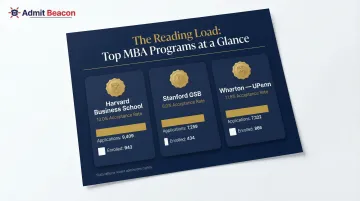
Every application receives at least two independent reads from admissions board members at both HBS and Wharton. Schools don't publish exact reading times, but research on high-volume document review tells a clear story: recruiters spend 30 seconds to three minutes scanning resumes, and psychological studies show durable impressions form in under 30 seconds.
Your opening has seconds to signal that your essay deserves full attention.
Hook vs. Gimmick: The Specificity Test
A genuine opening draws readers in because it feels true and specific. A gimmick feels manufactured — and readers, especially experienced admissions readers, recognize the difference immediately.
Hook: "I delivered the news to my team at 11 PM on a Friday: we had 72 hours to rebuild the product roadmap from scratch."
Gimmick: "Leadership is a journey that begins with a single step."
The hook contains a subject, action, time constraint, and stakes. The gimmick could apply to anyone, anywhere. Specificity is what makes one memorable and the other forgettable.
Strong Opening Techniques for Personal Narratives
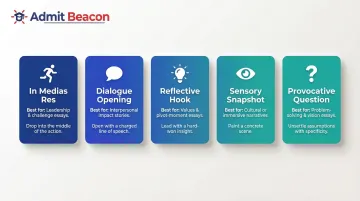
In Medias Res: Drop Into the Middle of the Action
In medias res—beginning mid-action, mid-scene, or mid-decision—works because it bypasses lengthy setup and trusts readers to orient themselves. The technique means "plunging into a crucial situation that is part of a related chain of events" rather than starting at the chronological beginning.
Find the single most charged moment in your story—the decision, the confrontation, the realization, the crisis. That's your entry point.
Action doesn't require physical drama. These all qualify:
- Walking into a boardroom to present a controversial recommendation
- Receiving feedback that challenges your self-perception
- Making a pivotal call during a business crisis
- Realizing your current path isn't aligned with your values
Your first sentence needs a subject, a verb, and one specific detail that grounds the reader immediately.
Example: "The CFO's question—'Why should we trust your forecast when the last three were wrong?'—hung in the conference room air while my team waited for my response."
Open with a Single Line of Dialogue
Dialogue creates immediacy, suggests character and conflict without explanation, and mimics walking into the middle of a real conversation.
Choose dialogue that carries tension or turning-point energy. The line should be surprising, emotionally loaded, and revealing about the speaker or situation.
Consider this opening: "'You're the only person on this team who thinks we should walk away from this client,' my manager said, and I realized I had a choice to make."
One caution: dialogue openings must feel earned. Generic exposition dressed as speech—"As you know, our Q3 results were disappointing"—weakens rather than strengthens an opening.
The Reflective Hook
A reflective opening begins with a declarative observation, hard-won insight, or philosophical statement that the story will then illustrate. Use it when the meaning of the experience is the true subject, not the event itself.
This technique fits best when:
- Your essay prompt asks you to define a concept (leadership, failure, impact)
- The insight you gained matters more than the chronology of events
- You want to frame the story before showing it
The risk: reflective openings easily tip into abstract cliché. "I have always believed that leadership means serving others" tells readers nothing. Ground your reflection in something hyper-specific to your experience.
Example: "I learned that leadership isn't about having the right answers when my team looked to me for direction and I had none to give—only questions we would need to answer together."
The Sensory Snapshot
A sensory snapshot uses 2-3 sentences to paint a concrete scene with specific sensory details—sight, sound, smell, texture—placing the reader in a moment before any action begins. The goal is atmosphere and emotional context, not description for its own sake.
Here's how that looks in practice: "The factory floor was louder than I expected—metal grinding metal, the acrid smell of cutting fluid, workers shouting over machinery. I had spent three years analyzing this operation from spreadsheets in Mumbai; now I was standing in it, realizing how much I didn't know."
The Provocative Question or Startling Detail
This technique opens with a question that genuinely unsettles assumptions or a counterintuitive fact about yourself or your situation.
Effective questions are specific, personal, and lead somewhere meaningful — they create cognitive dissonance rather than rhetorical filler. "Have you ever wondered what it means to lead?" could open any essay; it earns nothing. Startling details work the same way: they create a gap between expectation and reality that pulls readers forward.
Example: "I had been promoted four times in six years, but I couldn't explain why I wanted an MBA—and that realization stopped me cold."
How to Choose the Right Opening Technique for Your Story
Technique selection should be driven by the nature of your story, not personal preference or what sounds impressive.
If your story hinges on a dramatic turning point: In medias res or dialogue will serve it best.
If the insight is the point: A reflective hook may be more appropriate.
If setting and atmosphere are central: A sensory snapshot works.
The Common Trap: Premature Perfection
Many writers draft and redraft their opening endlessly before the rest of the essay exists. This is backwards. You cannot know what to lead with until you know what the story is actually about.
- Draft the body of your narrative first
- Return to write the opening after the full story exists
- You'll have clarity about which moment or insight deserves the lead
The Earned Opening
Once the full draft exists, the right opening usually reveals itself. The best first sentence is discovered in revision, not invention. Look for a line already buried in your draft that captures the story's emotional core, and move it to the top. Often your real opening is hiding in paragraph three — the moment you finally got to the point after warming up through context.
What This Means for Your MBA Application Essay
MBA personal narratives carry additional requirements beyond craft: they must simultaneously tell a compelling human story and demonstrate qualities admissions committees evaluate—leadership, self-awareness, growth, and coherent professional trajectory. Your opening needs to do both.
School-Specific Prompt Framing
Different prompts require different openings. A "Why MBA / Why now?" prompt calls for a different entry point than "Tell us about a failure" or "Define leadership."
HBS seeks candidates who are "business-minded, leadership-focused, and growth-oriented". Their prompts ask you to reflect on experiences that influenced career choices, shaped how you invest in others, and demonstrated curiosity. Your opening should signal impact, resourcefulness, and open-mindedness.
Stanford GSB evaluates "how you think, how you lead, and how you see the world". They explicitly want your genuine voice and introspection. Your opening should feel authentic and reveal something true about your values.
Wharton looks for what you will "achieve and contribute to the Wharton classroom, community, and post-MBA career". Your opening should signal focus, self-awareness, and community impact.
Read the prompt as a frame and ensure your opening sentence answers an implicit question the prompt is asking.
The Credential-Dump Trap
The most common MBA-specific opening mistake is beginning with professional credentials: "As a Senior Manager at X with 6 years in Y..."
This signals a missed opportunity. Admissions committees already have your résumé. The essay opening should show something the résumé cannot—how you think, what you value, how you've grown, what drives you.
Authenticity vs. Strategy
MBA applicants often over-engineer openings in an attempt to sound impressive, losing the authentic voice that actually makes essays memorable. A quiet, specific, first-person opening written in genuine voice consistently outperforms a polished but impersonal one.
HBS Managing Director Rupal Gadhia advises: "Just be careful in all that refining that you don't edit out your personality. Be authentic and be yourself!"
Start With Your Story Before Your Draft
Your opening doesn't come from a blank page — it comes from knowing which story you're telling. Before writing a single sentence, map your career narrative: what experiences connect, what growth you can demonstrate, what authentic motivation brought you to this moment.
This is where working with a structured consultant pays off. Admit Beacon's Essay Storyboarding process, for example, is built around helping applicants find the right entry point before drafting — so the opening feels earned rather than forced, and connects past experience to MBA goals in a way that reflects genuine motivation.
Opening Mistakes That Weaken Personal Narratives
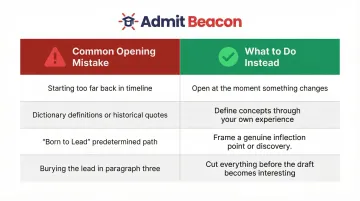
Starting Too Far Back in the Timeline
Many writers begin with unnecessary background—childhood influences, early career context, industry overviews—before the story actually starts. Admissions committees don't need warmup. Start where something actually changes.
What to do instead: Identify the moment your story truly begins (the decision, the challenge, the realization) and open there. Provide context later, only if essential.
Opening with Definitions or Dictionary Quotes
"Webster's Dictionary defines leadership as..." or "Throughout history, leaders have..." are among the first patterns experienced admissions readers recognize — and dismiss. Both signal that you're stalling rather than saying something only you could say.
What to do instead: Define concepts through your experience, not external sources. Show what leadership meant in your specific moment rather than citing what it means generally.
The "Born to Lead" Trap
Openings that imply you've always known your path, felt called to business, or been driven since childhood read as inauthentic to experienced readers. Few people have linear, destiny-driven career narratives — and admissions committees at top programs are specifically evaluating self-awareness and genuine growth. A predetermined-path story suggests neither.
What to do instead: Frame your story as a genuine inflection point, a moment of discovery or redirection, rather than the inevitable unfolding of a predetermined path.
Burying the Lead
The most compelling detail or moment often appears in paragraph three because writers warmed up through two paragraphs of context. If you find yourself finally "getting to the point" several sentences in, that point is probably your real opening.
What to do instead: Cut everything before the moment your draft becomes interesting. Start there.
Frequently Asked Questions
What are some good ways to start a personal narrative?
The five main techniques are dropping into action (in medias res), opening with dialogue, using a reflective statement, painting a sensory snapshot, or leading with a provocative question or surprising detail. The best choice depends on your story's nature—whether it centers on a turning point, an insight, or a specific setting.
What is a common mistake to avoid when opening a personal narrative?
The most frequent mistake is starting too far back in the timeline with unnecessary context or opening with a generic statement rather than a specific, grounded moment. Readers need to be placed immediately inside your story, not eased into it with background.
How long should the opening of a personal narrative be?
An opening can be as short as one sentence or as long as a short paragraph—typically 1-4 sentences. The goal is immediate engagement, not length. If readers aren't pulled in within the first few lines, the opening needs revision.
Can I start a personal narrative with a question?
A question can be effective when it's specific, thought-provoking, and personal. Generic rhetorical questions like "Have you ever wondered what it means to lead?" often weaken openings. The question must create real curiosity or genuine tension to work.
How do I choose between starting with action versus starting with reflection?
Action openings work best when your story's meaning emerges from what happens. Reflective openings work best when the insight itself is the central point. Draft the full narrative first, then decide which approach best captures your story's core.
What makes an MBA personal narrative opening stand out to admissions committees?
Admissions committees respond to openings that are specific, authentic in voice, and unexpected—something your résumé cannot convey. A single concrete detail or moment of genuine tension holds attention far better than a polished summary of credentials or a broad statement of ambition.