Introduction
Breaking into McKinsey, BCG, or Bain without an MBA is possible — but the numbers tell a harder story. According to 2022 data, 35% of all US MBB hires come from MBA programs, while lateral hires account for just 16%. Many candidates struggle to understand whether the degree is a genuine accelerator or just an expensive credential — and which path actually leads to an offer.
The answer depends on where you're starting from. For career switchers coming from engineering, tech, or finance, the MBA-to-consulting path offers structured access that's difficult to replicate otherwise. For those already in consulting, it can be the bridge to the associate-to-partner track. This article covers the concrete advantages an MBA provides, which programs offer the best shot at MBB and top firms, and what you risk by skipping it.
Key Takeaways
- An MBA is one of the most effective entry points into management consulting, with top firms actively recruiting from MBA campuses
- It accelerates skill development, opens structured recruiting pipelines, and delivers a significant salary bump at entry
- Current consultants who earn an MBA can leapfrog to senior roles, switch firms, or transition into MBB
- INSEAD, Kellogg, and Booth lead in MBB placement rates
- For career switchers, the MBA credential signals credibility that prior experience alone rarely provides
What Is an MBA for Consulting?
"MBA for consulting" refers to pursuing a full-time MBA specifically to enter or advance in management consulting. Firms like McKinsey, Bain, BCG, and Big Four strategy arms have historically preferred MBA graduates for associate-level and above roles.
This applies to two distinct groups:
- Career switchers using the MBA as a bridge from engineering, finance, tech, or other fields into consulting
- Practicing consultants looking to accelerate seniority, switch firms, or move from boutique to MBB
For both groups, the MBA serves the same purpose: a structured mechanism for building the skills, network, and recruiting access that consulting firms consistently look for at the associate and manager levels.
Key Advantages of an MBA for a Consulting Career
The advantages below are grounded in real recruiting outcomes, compensation data, and career trajectory patterns — not abstract claims about business education.
Advantage 1: Access to Structured MBB and Top-Firm Recruiting Pipelines
One of the most tangible advantages of an MBA is direct access to on-campus recruiting. Consulting firms, especially MBB, send recruiters, hold networking events, and extend internship offers almost exclusively through target MBA programs.
How the recruiting process works:
Firms arrive on campus in fall, host office-specific networking events, conduct internship interviews in January, and convert the majority of strong interns to full-time offers. MBA hires constitute 47% of McKinsey's US hires, 42% of BCG's, and 36% of Bain's. This pathway is nearly impossible to access as a lateral hire without an MBA.
Why this advantage matters:
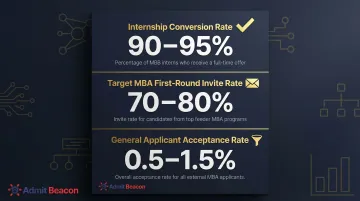
- MBB summer internship conversion rates average 90% to 95%
- Target MBA applicants see a 70% to 80% first-round interview invite rate, with an overall offer rate of 10% to 15%
- The general applicant acceptance rate at MBB is just 0.5% to 1.5%
When this advantage matters most:
This is especially critical for professionals pivoting into consulting from non-traditional backgrounds — engineers, tech professionals, non-profits — where no direct relationship with MBB exists. The MBA campus delivers interview access, recruiter relationships, and internship conversion rates that lateral candidates simply cannot replicate on their own timeline.
Kellogg's team-based assignments and peer reviews, for instance, produce graduates with measurably stronger collaboration skills — a trait that directly improves performance reviews and promotion velocity in consulting.
When this advantage matters most:
This matters most for STEM professionals, engineers, or technical specialists who have deep analytical ability but lack the client-facing communication skills and business breadth that consulting requires. Two years of structured coursework and live client projects compress what would otherwise be a decade of on-the-job learning.
Advantage 3: Significant Salary Uplift and Career Advancement
The skill development translates directly into compensation — and the numbers are substantial.
An MBA creates a measurable step change in consulting compensation. MBA associates at MBB firms enter at substantially higher base salaries:
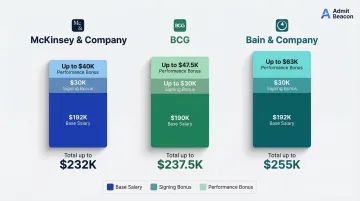
2024–2026 MBB post-MBA compensation:
- McKinsey: $192,000 base + $30,000 signing bonus + up to $40,000 performance bonus (Total: up to $232,000)
- BCG: $190,000 base + up to $30,000 signing bonus + up to $47,500 performance bonus (Total: up to $237,500)
- Bain: $192,000 base + $30,000 signing bonus + up to $63,000 performance bonus (Total: up to $255,000)
How the MBA affects long-term trajectory:
Consultants with MBA degrees from top programs typically reach engagement manager and principal roles within 3–4 years post-graduation. Kellogg's Class of 2024 reported a median base salary of $170,000, exactly double their median pre-MBA base salary of $85,000.
Why this advantage matters:
Even accounting for the cost of the degree, the financial return compounds significantly within 5–7 years. For consultants targeting a firm transition — for example, moving from a boutique to McKinsey, or from a Big Four strategy arm to BCG — the MBA creates the credibility and networking leverage that makes lateral senior-level moves feasible.
When this advantage matters most:
Most relevant for mid-career consultants (5–8 years of experience) who have hit a promotion ceiling at their current firm or who want to re-enter the industry at a more senior level after a pivot.
What Happens When You Skip the MBA in Consulting
The Promotion Ceiling Is Real
Without an MBA, many capable consultants find that advancement beyond senior analyst or engagement manager at top-tier firms becomes increasingly difficult. Firms structure their promotion tracks with the expectation that post-MBA associates will accelerate through the ranks faster — and they build pipeline accordingly.
That structural bias extends to hiring, not just promotion.
Breaking In Without One Is a Long Shot
Professionals from non-consulting backgrounds who try to enter MBB or top strategy firms without an MBA face a real structural disadvantage. Experienced professionals without prior MBB experience make up just 16% of total US MBB hires (McKinsey: 19%, BCG: 17%, Bain: 11%). Lateral hiring at these firms is limited, highly competitive, and typically favors candidates who already have comparable consulting experience.
The financial stakes compound this further.
The Salary Gap Starts on Day One
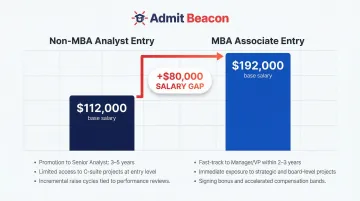
Non-MBA hires typically enter at the Analyst level (base ~$112,000) versus the MBA Associate level (base ~$192,000). Compensation does converge once non-MBA consultants reach Manager or Project Leader level. But that initial $80,000 gap represents years of lower earnings — and slower access to the high-value projects and client relationships that accelerate long-term careers.
How to Get the Most Out of Your MBA for a Consulting Career
The MBA's value in consulting is maximized when you're intentional from day one:
- Begin recruiting preparation before enrollment — firms begin on-campus recruiting in September
- Join the consulting club in week one — this is your primary source of case interview prep, networking events, and firm intelligence
- Identify internship target firms before classes start — the MBA summer internship between first and second year is the single most important recruiting milestone
These three steps converge on one high-stakes moment: the summer internship.
Treat your summer internship as a 10-week interview. The majority of full-time consulting offers at MBB come through internship conversion, so case interview prep and networking need to start well before you step on campus.
School selection shapes every recruiting opportunity that follows. A program with a strong consulting placement track record, active MBB recruiting presence, and a case-focused curriculum sets the conditions for converting preparation into offers — the degree alone doesn't do it.
Best MBA Programs for a Consulting Career
Most top MBA programs send graduates into consulting, but a handful of schools consistently dominate MBB placements. The right choice depends on four factors: consulting placement rate as a percentage of class, MBB firm recruiting presence, program culture, and curriculum fit with consulting skill development.
INSEAD
INSEAD is the global leader in total new MBB placements and is Bain's top global recruiting school. The Class of 2025 placed 50% of graduates into management consulting, with McKinsey (100 hires), BCG (60 hires), and Bain (51 hires).

The 10-month program structure is both an advantage (faster return to work) and a challenge (non-standard internship timing requires early preparation). The January intake includes a two-month summer break specifically designed for internships.
Kellogg School of Management
Kellogg's team-based pedagogy is a structural differentiator for consulting. Most assignments are completed in teams with peer reviews, developing the collaboration and communication skills consulting firms specifically test for.
The Class of 2025 placed 38% of graduates into consulting, with a median base salary of $190,000 and a median signing bonus of $30,000. MBB firms are listed as top employers.
Chicago Booth
Booth leads among U.S. programs by percentage of new students placed into MBB, with 36.7% of the Class of 2025 entering consulting. McKinsey, BCG, and Bain are its top three consulting recruiters: BCG (52 hires), McKinsey (35 hires), and Bain (30 hires).
Booth's median consulting base salary is $190,000. Its Nobel-faculty-driven analytical rigor aligns well with MBB's evidence-based approach to problem-solving.
Harvard Business School and Wharton
HBS placed 21% of its Class of 2025 into consulting and Wharton placed 28.2% — lower rates than Booth, Kellogg, or Tuck, reflecting broader career interest across finance, PE, and entrepreneurship.
All MBB firms recruit directly from both programs. For candidates whose profile fits these ecosystems, either school remains a strong path into consulting.
Here's how these programs compare at a glance:
| School | Consulting Placement (Class of 2025) | Median Base Salary | Key Differentiator |
|---|---|---|---|
| INSEAD | 50% | — | Highest total MBB hires globally; Bain's #1 recruiting school |
| Kellogg | 38% | $190,000 | Team-based curriculum builds consulting-specific collaboration skills |
| Chicago Booth | 36.7% | $190,000 | Leads U.S. programs in MBB placement percentage |
| HBS | 21% | — | Broad MBB recruiting presence; stronger in leadership roles |
| Wharton | 28.2% | — | Strong MBB access within a finance-heavy ecosystem |
Frequently Asked Questions
Is an MBA worth it for consulting?
Yes for most people targeting MBB or senior roles. The MBA unlocks structured recruiting access, higher entry-level compensation, and faster promotion tracks — benefits that compound and typically outweigh the cost of the degree within 5–7 years.
Which MBA is best for consulting?
INSEAD is the global leader for MBB placements, followed by Kellogg and Booth in the U.S. The "best" school depends on your target firms, career stage, and background — a consulting-focused school with strong MBB recruitment is the most important factor.
Can you make $300K in consulting?
Yes. Post-MBA consultants at MBB firms reach total compensation exceeding $300,000 when base salary, performance bonus, and other components are combined. For strong performers, this is typically achievable at the manager level, roughly 3–5 years post-MBA.
What is an MBA in consulting?
An MBA pursued specifically to enter or advance in management consulting — the most common use of the term. Some sources use "MBA consulting" to describe MBA admissions advising services; this article covers the career path, not the advising category.
Do you need an MBA to get into McKinsey, Bain, or BCG?
Not strictly. MBB firms hire undergraduates as analysts and occasional lateral hires at the pre-MBA level. But the associate level and above runs almost entirely through MBA recruiting — it is the primary entry point into senior consulting roles.
How long does it take to land a consulting job after an MBA?
Most offers are secured during the MBA itself. Internship offers typically come in January of first year, convert to full-time by end of summer, and students start immediately after graduation. From enrollment to first day on the job, the timeline is roughly 20–24 months.